Black and White Photography
by
Paul Roark
Welcome to My Home Page
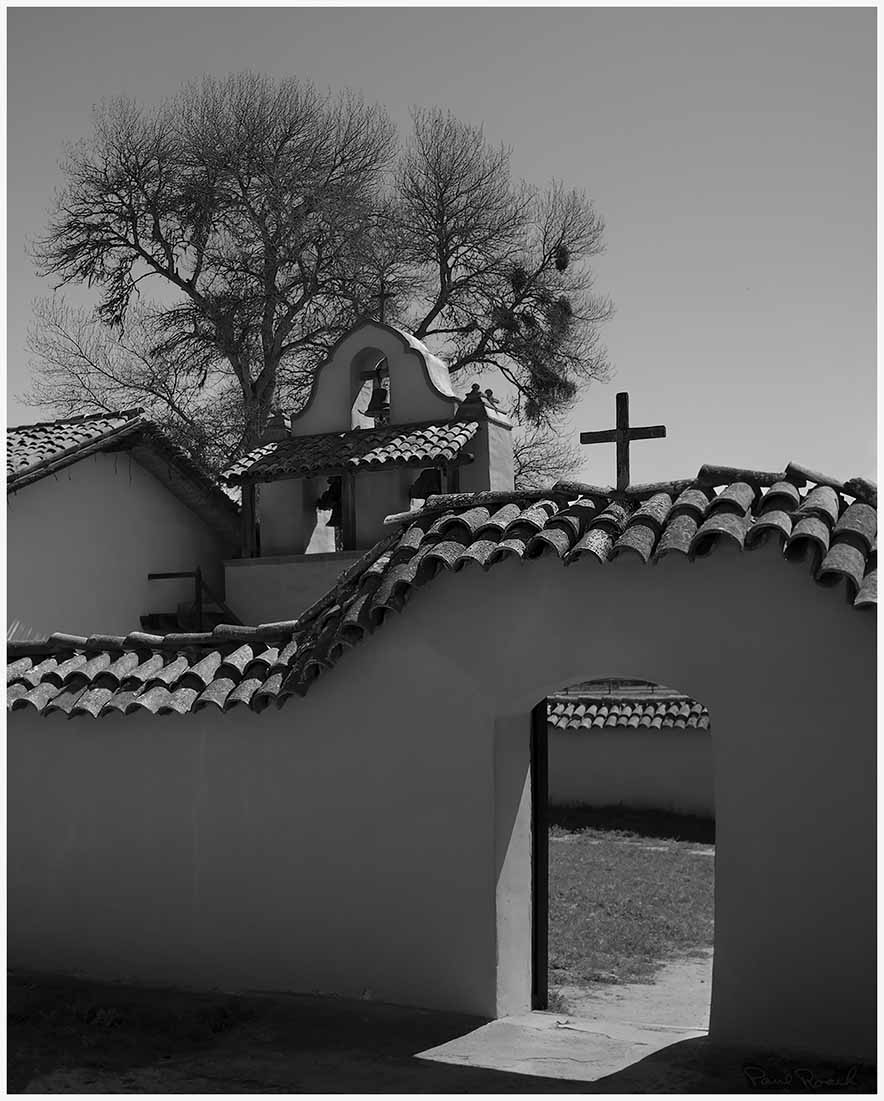
La Purisima Mission, California
For information on Gallery Los Olivos, click here.
Over the years, I have worked in several somewhat distinct media, including, traditional darkroom and silver printing, various internegative processes, and, in recent years, a variety of inkjet media. With the advent of modern inkjet printers and inks, it became clear that the silver print had become an "alternative" medium. The wet process has simply been eclipsed by the best modern digital approaches. One of my efforts has been to push the envelop in B&W inkjet printing, which has taken a back seat to color by the major printer companies. As a former darkroom worker who often mixed his own developers from the raw components (for example, POTA for Tech Pan film), the B&W inkset development work I did came rather naturally. (A brother who was a PhD chemist in the carbon field didn't hurt.)
At www.PaulRoark.com/BW-Info/ I cover or link to numerous current as well as older inksets and workflows that I have used in the past. For a number of years MIS Associates (inksupply.com) sold the older inksets that I developed. When their founder sold the company, it lost interest in B&W inks. I have continued to source the inputs for the former MIS inks through STS Inks in Florida. All of my B&W ink work and mixes are done on an open-source, royalty-free basis. I just make and continue to make what I want and have published my formulas and profiles.
Of particular interest to B&W printers who want the best for the least, the generic dilution base formulas for diluting matte black pigment inks is also linked to this page. These allow creative printers to make their own unique and very cost effective inksets, but for matte papers only.
My primary wide format printer (an Epson 9800) is loaded with a variant of what I call my "Glossy Carbon Variable Tone" inkset. This puts 100% carbon pigments, which are by far the most lightfast, in all but one of the ink positions. In one ink position I have a specially formulated "toner" that is light blue. This gives a print tone range from warm (natural carbon) to neutral, while at the same time keeping the job of making profiles rather simple.
The basic principle for making the most archival B&W prints is simply to keep the carbon content as high as possible for the tone you want, and use the best color (toner) pigments available. This maximizes longevity and virtually emiminates artifacts such as metamerism.
I generally print on Red River UltraPro Satin paper and coat the prints with Premier Art's Print Shield. I mount the prints on acid free foam core or, for very large prints, have a service bureau mount them on a substrate that is appropriate for the size of the print. I currently (2023) use a pressure sensitive adhesive and 25" wide pressure roller to get the best, bubble-free and acid-free display mounts for my 22 by 28 inch prints for wall display.
Over the years I have used B&W film sizes from 4x5 to 35mm. In the film era, I thought medium format film was the best compromise. 35mm film didn't quite hit the sharpness I like, and 4x5 was a bit too heavy, slow, and, frankly, not necessary for the 16x20 inch display prints that were the easiest reasonable size wall display prints to make in the traditional darkroom I grew up with. I became a fan of Rollei 2 1/4 film cameras. My SL66 still sits proudly in a display case in my home, being, in my view, the most practical film format of the era camera that, with its built-in tilt function, could capture foreground to background sharpness comparable to the "view cameras" (sheet film cameras with bellows).
With digital technology, I have found that my "Dual Focus" approach is very useful and a viable alternative to the tilt function for capturing excellent depth of field. I take one shot of the foreground and one at the accuratelly-set infinity stop -- very quickly. They can usual be merged into a single image. It usually works. Note that a monopod can be useful for this "DF" approach.
With today's technology, my current favorite interchangeable lens camera is a Sony a7c. A 25 mp sensor is enough. My latest purchase is the aps-c Fuji x100v. With the advent of AI Gigapixel, the smaller frame appears to be viable. This next year's experience will tell me.
In my initial outing with the aps-c Fuji, I would say the limiting factor may be the accuracy of the autofocus. Contolling where it focuses and the f-stop needed for DOF is going to be necessary. Whether the viewfinder gives enough information to make this determination is questionalbe.
How I judge the sharpness of a lens now has been affected by the availability of Topaz's AI Gigapixel software. With this software, the question is whether the image file is "sharp enough" for the software to recognize what is supposed to be a sharp edge, further sharpness is of little value. This Topaz software has convinced me that "AI" is a field to keep an eye on; it appears to be more significant than just the usual hype.
For technical information on lens performance, see the MTF curves/charts at https://www.paulroark.com/MTF-Curves-LiecaM-Sony.jpg.
In general, B&W prints are available in a number of sizes from 8x10 up to 44" wide (Epson 9800). All are printed with a dedicated B&W, carbon pigment inkset of my own design. I do not sell color prints.
All of my prints are made individually, as needed.
Arches prints - "Carbon on Cotton":
I consider my most archival print technology to be 100% carbon pigments on Arches Hot Press (uncoated) watercolor paper. While I like the nature of this medium, I've found the market is simply interested in the image. All of my prints use predominantly carbon pigments that will outlive all of us.
The December 2013 "Shutterbug" magazine, in the Digital Help column regarding inks suggested, "visiting a black-and-white expert's website, www.PaulRoark.com."
In June 2018 I was featured on the Red River webpage/blog. The article can be see here.
From mid-Februry to mid-April 2019 a broad cross-section of my work was featured at the Elverhoj Museum in
Solvang, California. Click
here for a copy of the postcard relating to the exhibit. For a copy of the review of the Elverhoj show by the SB Newspress,
click here.
And there is always an exhibit of my work at Gallery Los Olivos (see above).
Thank you for visiting my humble website.
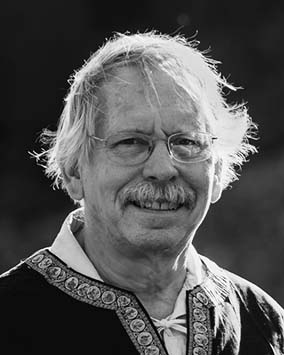
Paul Roark
Solvang, CA, USA
www.PaulRoark.com
All Photographs -- Copyright 1980-2023 Paul Roark -- All Rights Reserved